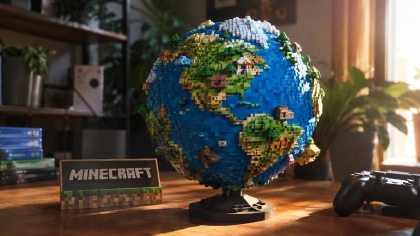
One block equals one meter: that is how the 22-year-old student known as Manifold recreated all of Switzerland inside Minecraft, covering an area of 41,285 square kilometers. The project is based on open geographic data, and anyone can try the Jungfrau-Aletsch region for free.
The project, called Blocks, transforms maps and terrain models into an explorable world. On its website, Manifold lets users compare the build with a real swisstopo aerial photograph using a slider; selecting a point on the map displays the command to teleport there in the game.
From official data to Minecraft mountains
Manifold, a student at ETH Zurich, taught himself 3D modeling and how to work with geographic data. As he told 20 Minuten, the idea began with a desire to have «the Swiss mountains and valleys as physical models». To turn that interest into an entire territory, he used public data from swisstopo, the Swiss Federal Office of Topography.
The Blocks website sums up the scale with a simple image: each block measures one meter. The terrain, glaciers, lakes, forests, and dams are generated from geodata rather than built by hand, and mountain heights are rounded to the nearest meter. The summit of the Matterhorn appears at 4,477 meters, compared with 4,478 meters in the elevation model cited by Manifold.
The terrain comes from swissALTI3D; swissBATHY3D data is used for lakes and underwater terrain; forest and tree heights are taken from swissSURFACE3D, and buildings are based on swissBUILDINGS3D. The Blocks data inventory also mentions swisstopo sources covering roads, railways, bridges, dams, snow, and glacier debris, along with datasets from other Swiss institutions.
The Federal Office of Topography opened its maps, aerial photographs, and landscape models on March 1, 2021, for free use, including commercial purposes. Manifold credits this policy with making the project possible: he says Switzerland stands out because he knows of no other place with comparably detailed open data available for the entire country.
«This project is only possible because Switzerland makes its geographic data freely available to the public».
— Manifold, according to Xataka
From Jungfrau-Aletsch to the complete map
The Blocks page offers a free download of the Jungfrau-Aletsch protected area, recognized as a UNESCO World Heritage Site. The area covers around 2,400 square kilometers and includes the Eiger, Mönch, Jungfrau, Aletsch Glacier, and Oeschinensee. Its ZIP file, prepared for Prism, takes up 1.1 GB and requires no registration.
The map of all Switzerland covers 41,285 km² and its download takes up 24 GB. It includes the world, a mod, textures, and shaders; Blocks says Minecraft Java, 16 GB of RAM, and 60 GB of free space are also required. The game builds the world as locations are visited, so the first time you arrive in an area may take a few minutes.
Full access is in Early Access: it is playable, but unfinished. The license costs at least 15 Swiss francs; higher amounts are an additional voluntary payment for the same license, not a donation. The website says the complete world requires more space and may take longer to load than the free area, so it recommends trying the latter first.
To run it, Blocks recommends importing the ZIP into Prism Launcher, starting the instance, and creating a world in creative mode. The guide notes that Forge and Java 8 can be downloaded through Prism; to get the lighting look seen in the videos, you can add OptiFine 1.12.2 HD U F5. The pack is prepared for Minecraft Java 1.12.2 and uses Cubic Chunks.
A detailed recreation, with explicit limitations
The creator warns that the 1:1 scale does not make the world a perfect copy. Heights are rounded, buildings are simplified, and bridges, roads, trees, and bodies of water may be missing or inaccurate. Accuracy varies depending on the data available for each area, and checks have been carried out by sampling rather than meter by meter.
Outside Switzerland and along some stretches of the border, the terrain comes from Copernicus, a model with points every 30 meters that is less detailed than the swisstopo data. There, the terrain may appear incomplete or flat; where building data is missing, trees may appear in their place, including near Geneva. The map covers the entire rectangle surrounding the country, so it includes areas of neighboring countries.
There are also performance and rendering issues that Blocks lists before purchase. With the default 8 GB of memory allocated to the game, gaps may appear in the distant view during many sessions. Flying at more than 50 times normal speed through places not yet visited can leave that view temporarily incomplete; and at a render distance of 32, the «Connection Lost» error has been observed in already explored areas, something that did not happen at the default value of 16.
Among the visual defects, some aged tiled roofs appear gray, and there are too many green roofs. Waterfalls on rocky faces, such as Staubbach, appear as black slits. Also, after an update, areas that have already been visited retain the state from the previous version: to see new roofs, you need to create a new world.
How it compares with maps of other countries
Switzerland is not the first country to arrive in Minecraft at real-world scale, although Manifold's project has a different resolution. In 2014, Denmark's geodata agency recreated Denmark with around 4,000 billion blocks based on its 3D elevation model. The initiative was conceived as an educational tool by Simon Kokkendorf, an agency employee.
A year earlier, the UK's Ordnance Survey brought Great Britain into the game with more than 22 billion blocks. Joseph Braybrook, then an intern, did the work using blocks that each represented 50 square meters. That scale offered a coarser aerial view than the Swiss map, where each block equals one meter.
The Blocks website features examples of recognizable places to explore: the Aletsch Glacier as seen from Eggishorn, the Lauterbrunnen Valley, Lake Walensee, and the north face of the Eiger, listed at 3,967 meters. It also shows the Grande Dixence, at 2,365 meters, and Konkordiaplatz on the Aletsch Glacier, at 2,700 meters.
What you need to try it
The free download lets you check whether the world works on your computer, but it is much smaller and does not guarantee the same performance across the entire country. Manifold says he tested the complete version on a MacBook Pro with Apple M1 Max and 64 GB of memory; the version dated October 19, 2026, was also tested on a PC with AMD Ryzen 7 7800X3D, NVIDIA RTX 4070, and 32 GB of RAM. The project has also been tested on Linux.
The license is for the processed world files, not the original geographic data, which remain free to use under the terms set by their owners. Blocks is not an official Minecraft product and is not approved by or associated with Mojang or Microsoft. The website specifies that later versions can be downloaded at no extra cost if they are released, but does not promise updates, dates, or any particular duration for the download service.
The terms of sale in effect from November 13, 2026, identify the seller as Beda Good, a sole proprietor operating as Manifold. For anyone under 18, the purchase requires the consent of a parent or guardian. Blocks advises reading the requirements and known issues and trying Jungfrau-Aletsch first; the page also explains that there are no voluntary refunds, without prejudice to applicable statutory rights.
The website also links to a Discord community where users can share favorite places, ask for help, and suggest what could be added. If an area has errors, Manifold invites users to report them to help improve future versions, although he does not commit to releasing an update.
Sources: Xataka, Blocks, Manifold (project website)